
The Global Compute Reserve

THE PLAYBOOK

Understanding the infrastructure, economics and technology behind the next computing economy.

01 · The Compute Economy Is Already Here

Hundreds of billions of dollars are already committed to computing infrastructure. Sovereign states are building out compute capacity as a matter of national strategy. Private corporations are constructing their own infrastructure at unprecedented scale. And investors are financing the semiconductors, servers, data centres, energy, and networks that make it all possible.

The compute economy is not a future concept. It is already being built.

The question is no longer whether this economy exists. It is who has strategic access to the infrastructure powering it.

02 · Why Computation Is Becoming Strategic

Throughout history, certain resources have defined the balance of economic and strategic power. Oil. Gold. Energy. Critical minerals. Infrastructure. Each one became strategic because it was scarce, contested, and essential to everything built on top of it.

Computing is following the same path. Beneath every modern economy sits an infrastructure stack:

SEMICONDUCTORSSERVERSDATA CENTRESENERGYNETWORKSSOFTWAREPROTOCOLS

Artificial intelligence is accelerating demand across every layer of that stack — more silicon, more servers, more data centres, more energy, more networks. As demand compounds, the resource at the centre of it all becomes newly strategic:

Computing capacity.

03 · The Scale of the Market

The numbers behind the compute economy are already enormous — and they are projected to grow further. The figures below are illustrative estimates of scale, not guaranteed outcomes.

$723B

Global public-cloud spending

2025

~$1.5T

Projected public-cloud market

Within several years

485 TWh

Data-centre electricity consumption

2025

~950 TWh

Projected data-centre electricity consumption

2030

$31.6T

Projected AI and data-centre infrastructure investment

Through 2050

Bar-graph infographic illustrating the scale of the global compute market
Illustrative scale of the compute economy. Projections are estimates, not guaranteed outcomes.

04 · Centralized Computing

Today, computing is overwhelmingly centralized. A small number of companies control massive compute capacity, data centres, networking infrastructure, cloud platforms, capital, data, and developer ecosystems.

This concentration gives a handful of organizations enormous leverage over who can build, who can scale, and who can access the infrastructure the economy runs on. It raises a fundamental question:

Can computing infrastructure itself become more open, distributed and independently governed?

05 · Decentralized Computing

Decentralized computing offers a different model. Instead of a few companies controlling the infrastructure, computation is spread across independent infrastructure, replicated computation, cryptographic verification, fault tolerance, network-level governance, programmable infrastructure, and geographically distributed operators.

The objective is not merely cheaper cloud. It is a fundamentally different infrastructure model — one where no single party controls the substrate on which the economy runs.

06 · ICP

The Internet Computer Protocol (ICP) is a decentralized network of independent subnets. Computation is executed by canisters and replicated across the network, providing decentralized computation, replicated execution, cryptographic security, chain-key cryptography, network-level governance, horizontal scaling through additional subnets, and programmable infrastructure.

The contrast is stark. Amazon sells you access to someone else's computers. ICP turns computing infrastructure into a shared, cryptographically secured protocol.

ICP Cloud Engines

ICP Cloud Engines — the practical layer of decentralized compute — is unpacked in detail on the compute page.

Explore ICP Cloud Engines

07 · ICP → Cycles

ICP converts into cycles — the unit used to pay for computation, storage, and network resources on the Internet Computer. This conversion is what connects ICP's economic value to the operation of decentralized computing infrastructure.

In other words, holding ICP is not just holding a token. It is exposure to the cost of running decentralized computation itself.

08 · The Network Nervous System

The Network Nervous System (NNS) is the governance layer of the Internet Computer. By locking ICP into neurons, participants gain governance rights and earn voting rewards according to network rules — including dissolve delay and neuron age.

This is a meaningful distinction from simply holding a cryptocurrency. You can participate in the network itself.

09 · Strategic Compute Reserves

This brings us to the central research concept: the strategic compute reserve. It refers to potential exposure to physical compute infrastructure, energy infrastructure, cloud capacity, decentralized computing networks, compute-related protocols, and strategic digital infrastructure.

The Global Compute Reserve studies this category. It does not assume one outcome. It examines the infrastructure, the economics, and the technology — and lets the evidence speak.

10 · A Possible Decentralized Compute Reserve

ICP offers a concrete case study of what a decentralized compute reserve could look like — combining five dimensions:

Computation

Programmable decentralized infrastructure

Economics

ICP → cycles → computation

Governance

Network Nervous System

Infrastructure

Independent nodes and geographically distributed data centres

Security

Cryptographic protocols and replicated execution

11 · The Investment / Valuation Question

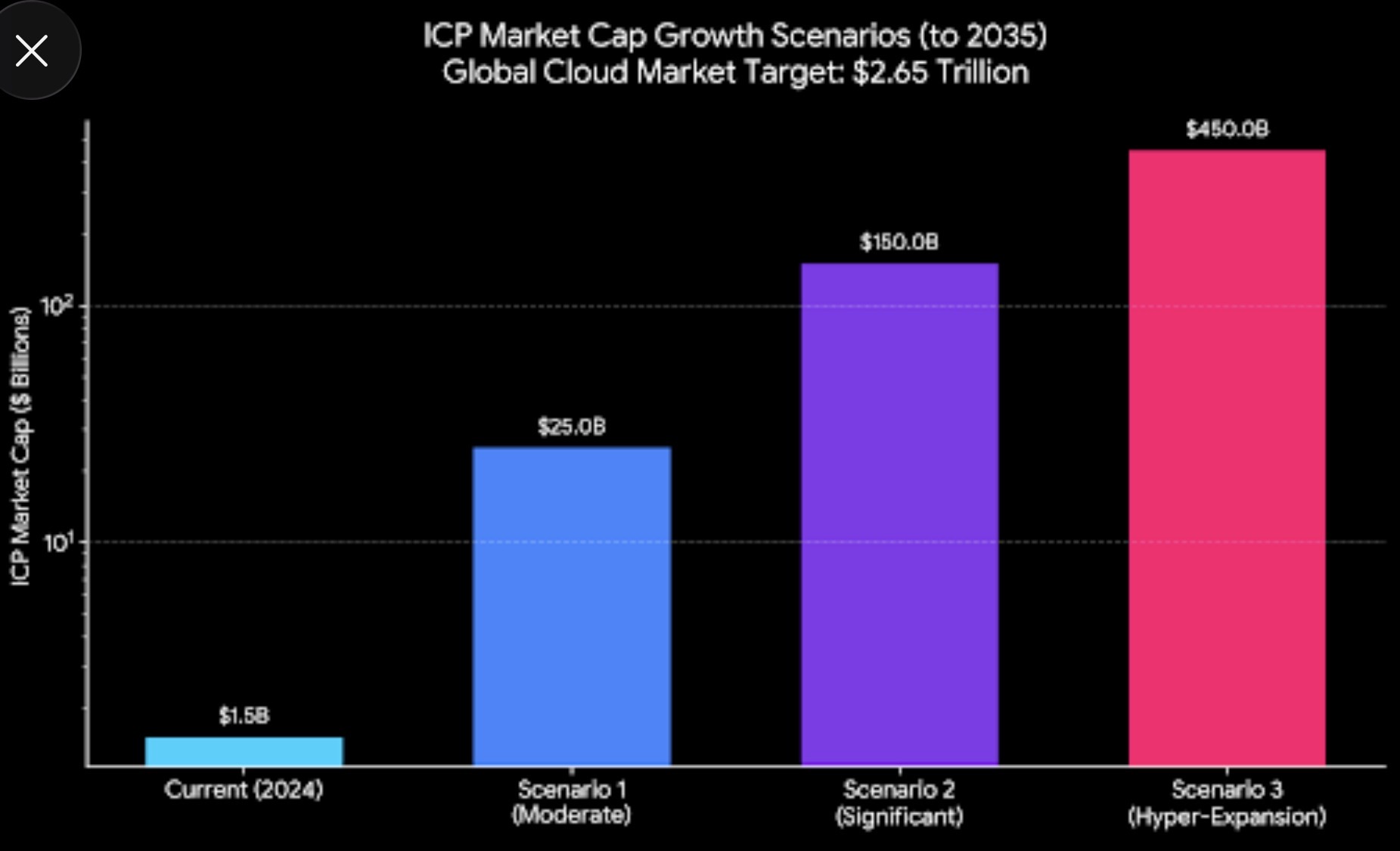
ICP's network valuation is relatively small compared to the broader cloud economy. To understand the scale of the opportunity — not to predict ICP's price — consider illustrative market-share scenarios on a $2.65T long-term global cloud-computing market:

Market shareImplied value
0.1%$2.65B
0.5%$13.25B
1%$26.5B
2%$53B
5%$132.5B

These are illustrative scenarios, not forecasts. The purpose is to understand the scale of the opportunity — not to predict ICP's price.

12 · The Reserve Question

The right question is not "Will ICP go up?" It is a deeper one:

Does decentralized computing become strategically important infrastructure?

If it does, the implications for infrastructure, economics, and governance are significant — regardless of any single token's price.

13 · Risks and Open Questions

No serious research treats this as settled. The open questions span adoption, developer demand, infrastructure growth, economics, regulation, governance, competition, network security, decentralization, institutional acceptance, technological change, and capital requirements.

The purpose of the Global Compute Reserve is to study these risks — not to eliminate them, and not to pretend they do not exist.

AdoptionDeveloper demandInfrastructure growthEconomicsRegulationGovernanceCompetitionNetwork securityDecentralizationInstitutional acceptanceTechnological changeCapital requirements

14 · How to Think About a Compute Reserve

01

Start with the infrastructure.

Understand the physical layer — the semiconductors, servers, data centres, energy, and networks that computation actually runs on.

02

Understand the resource.

See computing capacity as a strategic resource with real scarcity, real cost, and real concentration.

03

Understand the network.

Study how decentralized networks govern themselves, replicate computation, and secure their infrastructure.

04

Understand the economics.

Trace how value flows from infrastructure to tokens, cycles, and the operation of the network itself.

05

Understand the risks.

Weigh adoption, security, governance, and competition honestly. Then decide for yourself.

Founders Membership

Want to see the research happen?

Public research explains what I'm seeing. Founders Membership shows what I'm actually doing.

NNS Walkthroughs

Neuron setup, staking, maturity and governance

ICP Research

Deep dives into the network, infrastructure and economics

Decentralized Computing

Real demonstrations and implementation

Analytics

Market data, network activity, projections and scenarios

Predictions

What I think happens next — and why

Experiments

Testing ideas directly from the computer

Founder Updates

What I'm building, testing and learning

Live Research Sessions

Members can join live YouTube sessions and interact through live chat; recordings remain available afterward

This isn't a course recorded once. You're watching the research happen.

Join the Founders Membership

$14.99 CAD / month · via YouTube

Global Compute Reserve

Computation is the infrastructure.

Understand it. Research it. Prepare for it.

— JJB

Justin Jack Bear Towell, founder of the Global Compute Reserve

Founder

JJB

Justin Jack Bear Towell is a developer, entrepreneur and researcher studying the infrastructure, economics and sovereignty of the next computing economy.

Founder, Global Compute Reserve and thesmartcloud.org